
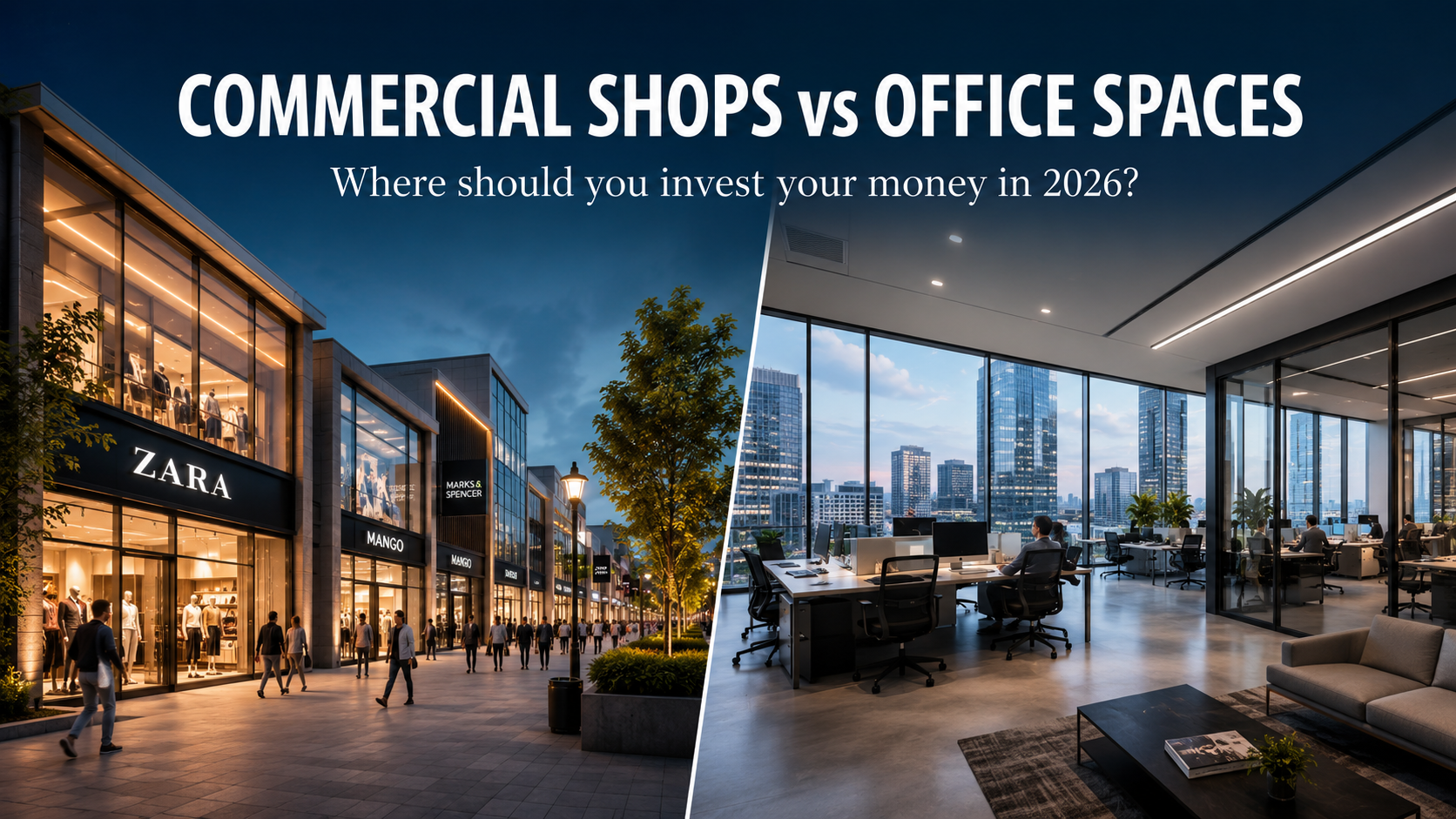
If you’ve been planning to invest in commercial real estate, you’ve probably asked yourself one question more than once Should I buy a commercial shop or invest in an office space?
Commercial Shops vs Office Spaces: Where Should You Invest Your Money?
It sounds like a simple choice, but it isn’t.
Both options have their own advantages, challenges, and long-term potential. The right investment depends on what you’re looking for. Do you want regular rental income? Are you hoping for long-term appreciation? Or are you searching for a property that stays occupied with minimal effort?
These are the questions every smart investor asks before putting their money into commercial real estate.
Interestingly, the commercial property market in India has changed significantly over the last few years. Businesses have evolved, workspaces have transformed, and consumer shopping habits have shifted. Yet, despite these changes, both commercial shops and office spaces continue to attract investors because they serve different purposes.
As per recent housing and commercial demand trends across major NCR markets, investor interest in commercial assets continues to grow, especially in developing business corridors where infrastructure projects are improving connectivity and increasing business activity.
So, where should you invest your money in 2026?
Let’s break it down.
Why Commercial Real Estate Continues to Attract Investors
Residential properties are often the first choice for new investors. However, many experienced investors gradually shift towards commercial properties.
Why?
Because commercial assets generally offer:
- Higher rental yields
- Longer lease agreements
- Better appreciation in business locations
- Lower vacancy in well-developed commercial hubs
- Stable cash flow over time
Of course, nothing is guaranteed. Every investment carries risks. But commercial properties often generate stronger returns when chosen carefully.
And that makes a big difference.
Understanding Commercial Shops
Walk into any busy marketplace, shopping complex, or high street, and you’ll immediately notice one thing.
People are always shopping.
Whether it’s a café, pharmacy, salon, clothing store, restaurant, or grocery outlet, retail businesses rely on physical visibility. That’s exactly why commercial shops continue to remain one of the most sought-after investment options.
A commercial shop is designed for businesses that interact directly with customers. Location plays a huge role here.
One common observation many property buyers share is this: two shops in the same building can perform very differently simply because one faces the main road while the other is tucked away inside the complex.
That matters more than glossy brochures.
Benefits of Investing in Commercial Shops
One of the biggest advantages of owning a commercial shop is visibility.
Retail businesses depend on footfall. The more people passing by, the better the chances of attracting customers.
Because of this, shops located near metro stations, residential communities, schools, hospitals, or busy intersections often command premium rentals.
Other advantages include:
| Benefit | Why It Matters |
| High Rental Yield | Prime retail locations usually generate attractive rental income. |
| Strong Demand | Everyday businesses constantly look for retail space. |
| Better Appreciation | Popular commercial markets often witness healthy capital appreciation. |
| Flexible Tenant Options | Restaurants, pharmacies, salons, boutiques, cafés, and convenience stores all require shop spaces. |
But There Are Challenges Too
Every investment has two sides.
Commercial shops are no exception.
Retail businesses depend heavily on customer traffic.
If a shopping complex fails to attract visitors, tenants may struggle to run profitable businesses. Eventually, vacancy rates can increase.
Parking issues, poor maintenance, weak property management, and oversupply in the surrounding area can also affect returns.
That’s why experienced investors rarely purchase a shop based only on attractive brochures or launch offers.
They visit the location.
Sometimes more than once.
Morning traffic feels different from evening traffic.
Weekends tell another story altogether.
These small observations often reveal far more than glossy advertisements ever can.
Understanding Office Spaces
Office spaces serve an entirely different purpose.
Instead of attracting shoppers, they accommodate businesses.
Corporate offices, startups, IT companies, legal firms, consultants, digital marketing agencies, healthcare professionals, financial advisors, architects, and educational organizations all require office spaces.
The interesting part?
Unlike retail businesses, office tenants usually prefer stability.
Many companies sign lease agreements for three to nine years, depending on the location and business requirements.
For investors, that often translates into predictable rental income.
Why Office Spaces Continue to Grow
The way people work has certainly changed.
Remote work became popular for some industries. Hybrid work also became common.
But here’s something many people overlook.
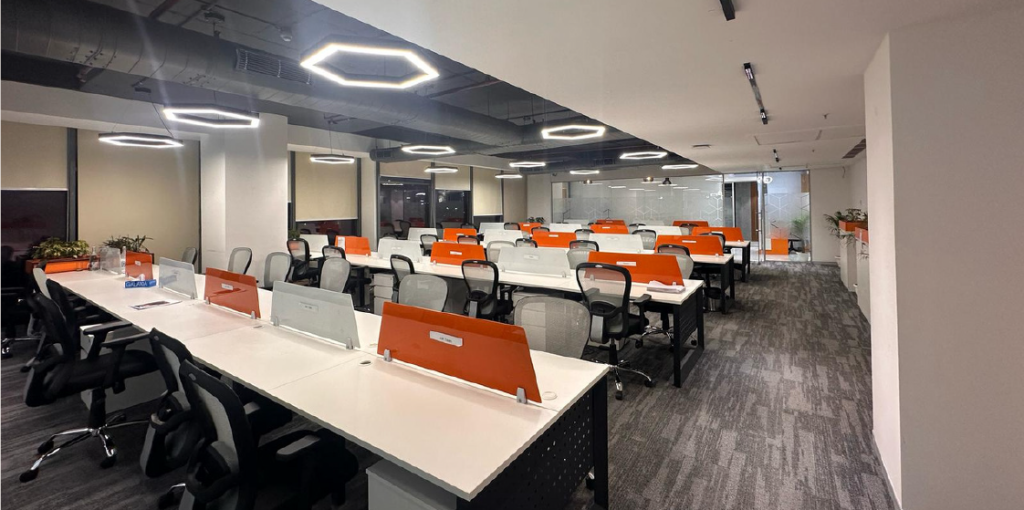
Businesses still need professional office addresses.
Clients expect meetings.
Teams collaborate better in dedicated workspaces.
Growing companies eventually outgrow coworking spaces and move into permanent offices.
In business districts across NCR, Bengaluru, Hyderabad, Pune, and Mumbai, demand for quality office spaces remains strong, particularly in Grade A commercial developments with excellent connectivity.
Advantages of Investing in Office Spaces
Office spaces offer several benefits that appeal to long-term investors.
One major advantage is lease duration.
Unlike many retail businesses that may relocate frequently, office tenants often stay longer because shifting operations involves significant cost and disruption.
Other advantages include:
- Longer lease agreements
- Predictable rental income
- Professional tenants
- Lower maintenance disputes
- Stable occupancy in prime business districts
If your goal is consistent passive income over several years, office spaces deserve serious consideration.
A Small Story That Changed One Investor’s Perspective
A friend of mine was convinced that buying a retail shop would always generate higher returns.
He shortlisted three commercial projects.
The brochures looked fantastic.
Premium architecture.
Luxury branding.
Big promises.
Then he spent an entire Saturday visiting each location.
The first project was almost empty.
The second had excellent construction but poor accessibility.
The third wasn’t the fanciest. In fact, it looked surprisingly simple.
But the parking was full.
Families were walking around.
Restaurants were busy.
Children were enjoying the open spaces.
Within an hour, he realized something important.
Buildings don’t generate returns.
People do.
That single visit completely changed his investment decision.
And honestly, that’s a lesson every commercial property investor should remember.
Commercial Shops vs Office Spaces: A Side-by-Side Comparison
By now, you’ve probably realized that neither option is universally “better.” The right investment depends on your financial goals, risk appetite, and investment horizon.
Here’s a practical comparison to make things easier.
| Factor | Commercial Shops | Office Spaces |
| Rental Yield | Usually Higher | Stable and Consistent |
| Lease Duration | 1–5 Years | 3–9 Years |
| Tenant Type | Retail Businesses | Corporates, Startups, Professionals |
| Footfall Dependency | High | Low |
| Vacancy Risk | Moderate | Lower in Business Hubs |
| Capital Appreciation | High in Prime Retail Areas | Strong in Growing Business Districts |
| Maintenance | Slightly Higher | Generally Lower |
| Initial Investment | Moderate to High | Moderate to High |
| Best For | Investors seeking higher rental income | Investors seeking long-term stability |
Looking at the table, it’s easy to think commercial shops are the obvious winner because of their higher rental yields. But investing isn’t just about chasing the biggest numbers.
Consistency often beats excitement.
A shop earning exceptional rent today might remain vacant for months if the tenant leaves. On the other hand, a well-located office with a reliable corporate tenant can provide uninterrupted rental income for years.
That’s why experienced investors focus on the complete picture rather than a single metric.
Rental Income: Which Investment Pays Better?
Rental income is one of the biggest reasons people choose commercial real estate over residential property.
Generally speaking, commercial shops tend to generate higher rental yields because retail businesses rely heavily on location and customer visibility.
A pharmacy at the entrance of a busy residential township, for example, may be willing to pay a premium rent because of consistent customer traffic.
Similarly, cafés, restaurants, branded fashion outlets, and supermarkets often compete for well-positioned retail spaces.
Office spaces, meanwhile, usually offer slightly lower rental yields but compensate with greater stability.
Think about it this way.
A growing IT company doesn’t relocate every year.
Neither does a law firm or a chartered accountant’s office.
Relocating an office involves operational disruption, employee inconvenience, infrastructure costs, and branding challenges.
As a result, office tenants often stay longer.
That predictability is valuable.
Especially if your goal is passive income.
Here’s a Simple Example
Imagine two investors purchase properties worth ₹1 crore.
Investor A buys a retail shop.
Investor B purchases an office space.
The retail shop may generate higher rent during peak business years.
However, if the tenant vacates, finding another suitable retailer may take time.
Meanwhile, the office owner may receive slightly lower rent but continue earning consistently because the corporate tenant has signed a long-term lease.
Neither investment is wrong.
They’re simply built for different investment strategies.
What About Property Appreciation?
Rental income is only one side of commercial investing.
Capital appreciation matters just as much.
A property that increases significantly in value over the next decade can deliver excellent overall returns, even if rental income remains average.
Commercial shops often appreciate faster in locations where residential populations are growing.
Think about newly developing sectors.
A few years ago, there might have been only empty land.
Today, there are apartments.
Tomorrow, schools, hospitals, cafés, supermarkets, banks, gyms, and restaurants will follow.
Retail demand naturally increases.
Office spaces, on the other hand, usually appreciate based on business activity.
New expressways, metro connectivity, IT parks, business districts, and infrastructure projects attract companies.
As more businesses move into an area, demand for office spaces rises.
Both property types can appreciate well.
The difference lies in what drives that appreciation.
Risk Factors Every Investor Should Know
Let’s be honest.
No investment is risk-free.
Commercial real estate is no exception.
The key isn’t avoiding risk altogether.
It’s understanding it before you invest.
Here are a few common challenges investors should consider.
| Risk | Commercial Shops | Office Spaces |
| Vacancy | Medium | Low to Medium |
| Market Slowdown | Moderate Impact | Moderate Impact |
| Tenant Turnover | Higher | Lower |
| Business Dependency | High | Moderate |
| Liquidity | Moderate | Moderate |
One common mistake buyers make is focusing only on the expected rental return.
They rarely ask questions like:
- How many businesses are already operating nearby?
- Is parking sufficient?
- How far is the nearest metro station?
- Who is the developer?
- What is the occupancy rate of nearby commercial projects?
- Is there enough residential population to support retail demand?
These questions often matter more than a discount on the purchase price.
Which Investment Fits Your Budget?
Your investment budget also plays an important role.
Here’s a simple guide.
| Budget | Recommended Option |
| ₹30–60 Lakhs | Smaller Retail Shop or Compact Office |
| ₹60 Lakhs–₹1.5 Crore | Premium Retail Shop or Mid-sized Office |
| ₹1.5 Crore+ | High-Street Retail, Grade A Office Space, or Multiple Units |
Instead of stretching your finances to buy a larger property, many experienced investors prefer purchasing a smaller unit in a stronger location.
Location almost always wins.
A modest shop in a thriving commercial hub can outperform a larger shop in a poorly connected area.
Who Should Invest in Commercial Shops?
Commercial shops are often a better fit if you:
- Want higher rental income.
- Are comfortable with moderate investment risk.
- Prefer locations with strong footfall.
- Can hold the investment for the long term.
- Believe in the growth of retail businesses.
Retail properties also work well for investors who understand local markets.
If you’ve spent years observing which commercial areas attract customers and which remain empty, that knowledge becomes a valuable advantage.
Who Should Invest in Office Spaces?
Office spaces may be more suitable if you:
- Prefer stable rental income.
- Want long-term corporate tenants.
- Value predictable cash flow.
- Are building a passive income portfolio.
- Prefer lower tenant turnover.
Many investors approaching retirement also lean towards office spaces because predictable monthly income often becomes more important than chasing maximum returns.
One Thing Many Buyers Overlook
After speaking with several property buyers over the years, one concern comes up repeatedly.
People often fall in love with the project before evaluating the location.
That’s understandable.
Beautiful sample offices.
Modern interiors.
Fancy reception areas.
Impressive marketing presentations.
Everything feels premium.
But when you step outside, the surrounding infrastructure tells the real story.
Is the road complete?
Are businesses already operating nearby?
Is there enough parking?
Will customers actually visit this location?
Those practical questions can make the difference between a successful investment and a disappointing one.
Brochures create interest.
Ground reality builds wealth.
Looking Beyond 2026
India’s commercial real estate sector continues to evolve.
Growing infrastructure, expanding metro networks, digital businesses, flexible workspaces, and increasing urbanization are creating fresh investment opportunities.
While retail remains essential for customer-facing businesses, office spaces continue to benefit from corporate expansion and the growing demand for organized workplaces.
Instead of asking, “Which property type is always better?”
Ask a more useful question.
“Which investment aligns with my financial goals over the next 10–15 years?”
That single shift in perspective often leads to smarter decisions.
So, Which One Should You Choose?
After comparing both options, one thing becomes clear—there isn’t a universal winner.
The better investment is the one that aligns with your financial goals.
If your priority is earning higher rental income from businesses that benefit from customer footfall, a commercial shop could be the right fit.
If you’re looking for predictable rental income, longer lease agreements, and relatively stable occupancy, an office space may suit your investment strategy better.
Here’s a simple way to think about it.
Choose a commercial shop if you:
- Want potentially higher rental yields.
- Are investing in a location with strong daily footfall.
- Don’t mind slightly higher tenant turnover.
- Are comfortable monitoring market trends.
Choose an office space if you:
- Prefer steady, long-term income.
- Want corporate tenants.
- Value stability over short-term gains.
- Are building a passive income portfolio.
Whichever option you choose, remember that successful commercial investing is rarely about buying the most expensive property.
It’s about buying the right property.
A well-located commercial unit with quality construction, reliable property management, and genuine future demand will usually outperform a larger property in the wrong location.
Patience matters.
Research matters even more.
And that combination often leads to better investment decisions.
Quick Comparison at a Glance
| If You Want… | Better Choice |
| Higher Rental Yield | Commercial Shop |
| Stable Monthly Income | Office Space |
| Long-Term Corporate Tenant | Office Space |
| Better Retail Appreciation | Commercial Shop |
| Lower Tenant Turnover | Office Space |
| Daily Customer Traffic | Commercial Shop |
| Predictable Cash Flow | Office Space |
| Long-Term Wealth Creation | Both (if chosen wisely) |
Frequently Asked Questions (FAQ)
1. Is investing in commercial property better than residential property?
Commercial properties generally offer higher rental yields and longer lease periods than residential properties. However, they also require a higher initial investment and careful location analysis. The right choice depends on your financial goals and investment horizon.
2. Which offers better rental income: commercial shops or office spaces?
Commercial shops often generate higher rental yields, especially in busy retail locations. Office spaces, however, usually provide more consistent rental income because corporate tenants tend to stay for longer periods.
3. Are office spaces a good investment in 2026?
Yes. As businesses continue to expand in major cities and emerging commercial hubs, demand for well-connected office spaces remains healthy. Premium office developments with modern amenities continue to attract long-term tenants.
4. What should I check before buying commercial property?
Before investing, evaluate:
- Location and connectivity
- Developer reputation
- Existing occupancy
- Future infrastructure plans
- Parking availability
- Expected rental demand
- Maintenance costs
- Legal approvals
A little research today can prevent expensive mistakes later.
5. Is commercial real estate suitable for first-time investors?
Yes, provided you understand the market and invest according to your budget. If you’re new to commercial real estate, consider consulting experienced professionals and comparing multiple projects before making a decision.
Final Thoughts
Commercial real estate isn’t about finding a “perfect” investment.
It’s about finding the investment that’s right for you.
Take the time to visit the location.
Observe the surroundings.
Talk to existing business owners if possible.
Look beyond marketing brochures.
The best investment decisions are usually made on the ground—not in a sales office.
Whether you choose a commercial shop or an office space, focus on quality, location, long-term demand, and realistic expectations.
Markets will change.
Business trends will evolve.
But properties in the right locations, backed by sound research, tend to stand the test of time.
Author Bio
The author is a real estate content specialist with a passion for simplifying property investment for everyday buyers. With years of experience researching residential and commercial real estate trends, the goal is to provide practical, unbiased insights that help readers make informed investment decisions. Every article is written with a focus on clarity, transparency, and long-term value rather than sales-driven advice.
Founder’s Note
Real estate is one of the biggest financial decisions most people make in their lifetime. This platform was created to make that journey easier by publishing reliable, research-backed, and easy-to-understand property guides. Whether you’re a first-time investor or an experienced buyer, our mission is to help you invest with confidence, backed by information you can trust.
Call to Action
Thinking about investing in commercial real estate?
Don’t rush the decision. Compare projects, evaluate locations, understand rental potential, and choose a property that matches your financial goals.
If you found this guide helpful, explore our other commercial property resources for more practical tips, market insights, and investment strategies to help you make smarter real estate decisions.