
UER-II and Dwarka Expressway: The Quiet Shift Reshaping NCR Real Estate Growth (2026)
If you’ve lived in or around Delhi NCR long enough, you don’t need a traffic report to tell you what’s wrong.
You feel it.
That slow crawl on NH-8.
The unpredictability of reaching North Delhi from Gurgaon.
And honestly, that constant mental calculation before leaving home — “Kitna time lagega?”
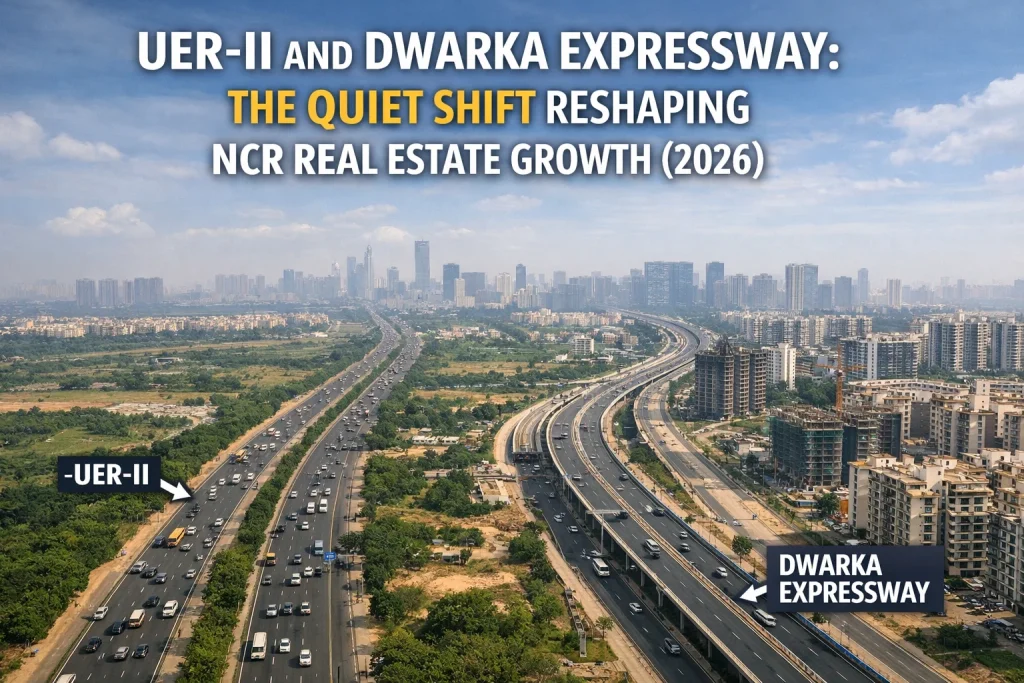
That’s exactly where Urban Extension Road 2 (UER-II) quietly changes the conversation.
Not dramatically. Not overnight.
But in a way that starts affecting real estate decisions—almost without you realizing it.
And when you connect that with the rise of the Dwarka Expressway, something interesting begins to happen.
Let’s break it down.
What is Urban Extension Road 2 (UER-II Delhi)?
The urban extension road 2 Delhi corridor isn’t just another infrastructure project. It’s more like a long-overdue correction.
For years, NCR traffic has depended on a few overloaded routes. Everyone knows them. Everyone avoids them. Still gets stuck.
UER-II changes that pattern.
It links parts of West Delhi more directly to outer and North Delhi zones, cutting across routes that earlier felt unnecessarily stretched.
Think of it like this:
Instead of funneling everything through the same old bottlenecks…
UER-II opens up a parallel path.
And that matters more than most glossy brochures will ever admit.
Because in NCR real estate, connectivity isn’t a feature—it quietly decides everything.
Why This Matters for Real Estate Growth
Here’s something most first-time buyers don’t realize immediately.
Property appreciation doesn’t really happen because of “fancy amenities” or launch offers.
It happens when daily movement becomes easier.
And right now, UER II Delhi + Dwarka Expressway is doing exactly that.
You can actually see the shift if you’ve been tracking site visits over the last year or so.
As per recent housing demand trends in NCR, first-time buyers now form a significant percentage of new bookings in emerging corridors.
That wasn’t the case even 3–4 years ago.
Developers are launching faster.
Inventory is moving a bit quicker than expected.
And buyers are slowly stepping out of their comfort zones.
Travel Time Comparison: Before vs After UER-II
Let’s make this practical.
From Dwarka Expressway (DXP) to North Delhi
Earlier (Without UER-II):
- Route: NH-8 → Ring Road → Inner Delhi roads
- Time to Rohini: 90–110 minutes (on a typical weekday evening)
- Time to Alipur: 100+ minutes
- Traffic unpredictability: Very high
Now (With UER-II Access):
- Route: More direct connectivity via UER-II link corridors
- Time to Rohini: 45–60 minutes
- Time to Alipur: 50–65 minutes
- Traffic flow: Noticeably smoother (not perfect, but better)
If you’ve ever spent 90 minutes stuck near Dhaula Kuan or crawling past Rajouri Garden, you already know why this matters.
It’s not just time saved.
It’s the mental fatigue you avoid.
Dwarka Expressway: More Than Just a Road
The dwarka express highway has been “almost ready” for years.
Most people had stopped taking timelines seriously.
But 2025–2026 feels different. You can sense it when you drive there.
You’ll notice:
- Operational stretches that actually feel usable
- Residential towers with lights on (not just sample flats)
- Active commercial construction
- Roads that are wider and, surprisingly, less chaotic
And maybe this is subjective—but the area feels less cluttered compared to older NCR pockets.
That’s rare.
Sector 111 Gurgaon: Why Buyers Are Paying Attention
Let’s talk about Sector 111 Gurgaon projects.
Because this is where things start getting interesting.
Many of my clients who were earlier focused only on Golf Course Extension Road didn’t even consider this side.
Too far. Too new. Too uncertain.
But after visiting two or three projects here—usually on a weekend—they start reconsidering.
What’s Working in Sector 111?
- Direct access to Dwarka Expressway
- Upcoming connectivity via UER-II
- Very close to Delhi border (this matters more than people admit)
- Entry prices still relatively reasonable
- More planned layouts compared to older sectors
One common complaint buyers share after living in West Delhi for years is simple:
“Space nahi hai.”
Not just inside homes. Outside too.
Parking issues. Congested lanes. Limited redevelopment.
Sector 111 feels… more open.
Not perfect. Still developing.
But you can see where it’s going.
Investment Comparison: Sector 111 vs West Delhi Colonies
Let’s be fair here.
West Delhi—areas like Janakpuri, Paschim Vihar—aren’t going anywhere. They’re established, emotionally rooted, and still very livable.
But from an investment lens, the equation is changing.
West Delhi (Established Colonies)
- High entry cost
- Price growth has slowed down
- Infrastructure stress is visible
- Redevelopment is complicated
- Rental yield is stable, but not exciting
Sector 111 & Dwarka Expressway Belt
- Prices still have room to grow
- Infrastructure is improving (not saturated yet)
- Planning is better in newer developments
- Demand is coming from working professionals
And here’s the key difference most investors are quietly noticing:
West Delhi is already valued.
Dwarka Expressway is still being valued.
That gap is where opportunity usually sits.
The Rise of Dwarka Expressway Residential Projects
If you visit multiple dwarka expressway residential projects back-to-back, a pattern starts emerging.
The buyer profile is changing.
Earlier, it was mostly investors testing the waters.
Now, you’ll see:
Young couples
Working professionals
Families upgrading from 2BHK to 3BHK
After visiting a few sites recently, one thing stood out.
People are asking more practical questions now:
- “School kitni door hai?”
- “Office commute realistic hai?”
- “Maintenance kitna hoga?”
Developers have also adapted.
They’re no longer just selling square footage.
They’re selling a more complete living setup—clubhouses, retail zones, open spaces.
Commercial Projects: The Missing Piece Now Falling Into Place
For a long time, one question kept coming up:
“Yahan jobs kahan se aayengi?”
Because residential growth without nearby work hubs doesn’t sustain.
That gap is slowly closing.
New commercial project developments along Dwarka Expressway are:
- Bringing office spaces closer
- Attracting smaller firms and startups
- Creating some level of local job ecosystem
It’s not Cyber City yet.
But it doesn’t need to be.
Even partial commercial activity improves livability significantly.
A Quick Look at UER 2 Map Impact
If you’ve seen a UER 2 map, you’ll notice it’s not just about roads.
It’s about how movement patterns change.
- Dwarka to North Delhi becomes more direct
- West Delhi gets alternative routes
- Daily travel becomes more predictable
And predictability, oddly enough, is a big deal for homebuyers.
Because people don’t just buy homes.
They buy routines.
Unexpected Story: A Site Visit That Changed Perspective
A couple of months back, I went for a site visit in Sector 111 with a buyer who was very clear:
“I’m only buying in West Delhi. Bas dekhne aa rahe hain.”
Fair enough.
We still went.
It was a Saturday, around 4:30 PM. Slight traffic, but manageable.
We walked through the sample apartment, then stepped out toward the open area.
He paused for a second and said:
“Yahan hawa thodi better lag rahi hai.”
It sounds like a small thing.
But it wasn’t about air quality.
It was about space.
Less congestion.
A different kind of environment.
He didn’t book that day.
But he called back after about 10–12 days.
That’s usually how decisions happen here—not instantly, but gradually.
Why Dwarka Expressway Investment Makes Sense in 2026
Let’s keep this realistic.
1. Infrastructure is Finally Visible
Not just promised—visible.
2. Connectivity is Improving
UER-II is playing a big role here.
3. Price Window Still Exists
Not cheap, but not fully peaked either.
4. End-User Demand is Increasing
Which stabilizes the market.
5. Balanced Growth
Residential + commercial together.
Should You Buy Dwarka Expressway Flats Now?
It depends.
If You’re an End-User:
This is a practical time to consider.
Better planning, improving roads, and relatively newer infrastructure.
If You’re an Investor:
Be slightly more selective.
Look at:
- Exact location
- Developer track record
- Possession timeline
Because not every project will perform the same way.
Internal Insight
One thing many buyers underestimate is financing clarity.
Loan approvals, hidden costs, EMI comfort—it all adds up.
(You can also read our detailed comparison of home loan options before finalizing.)
It saves a lot of last-minute stress.
NCR real estate doesn’t change in one big moment.
It shifts quietly. Then suddenly, everyone notices.
UER-II and Dwarka Expressway are somewhere in that middle phase right now.
Not fully obvious. Not completely hidden either.
And if you’re paying attention…
You can already see where things are heading.
The only real question is—
Do you wait for it to become obvious?
Or move when it still feels slightly uncertain.
FAQs
1. What is UER-II and why is it important?
UER-II improves connectivity between West and North Delhi, reducing travel time and boosting real estate demand.
2. Is Dwarka Expressway a good investment in 2026?
Yes, especially due to infrastructure progress and rising end-user demand.
3. Why is Sector 111 Gurgaon gaining attention?
Because of its location advantage, better planning, and future growth potential.
4. Are Dwarka Expressway flats good for living?
Yes, particularly for those looking for newer, better-planned housing.
5. How does UER-II impact property prices?
Improved connectivity increases demand, which supports price appreciation.
- Privacy Policy
- Disclaimer