

Buying a home is never just about walls, tiles, parking, or a loan file. It is much more personal than that.
It is the place where your family will wake up every morning. It is where your children may grow up, where festivals will be celebrated, where guests will come, and where normal everyday life will happen. That is why home buying always feels emotional, especially for first-time home buyers.
Still, emotion alone is not enough.
In 2026, buyers are asking smarter questions. They are not getting impressed only by sample flats, glossy brochures, or “limited period offer” banners. They want to know the truth. Is the project legally safe? Is the location practical? Will the EMI be manageable? Is the builder reliable? Is the area actually livable?
And honestly, this is a good change.
A few years ago, many people booked homes because someone told them, “This location will boom.” Today, buyers are more careful. They compare. They visit. They check reviews. They ask about RERA, possession, maintenance, and real connectivity.
So, is 2026 the best time to buy a home in 2026?
For the right buyer, it really might be.
1. First-Time Home Buyers Are Smarter Now
The biggest change in 2026 is not only in the real estate market. The biggest change is in the buyer.
First-time home buyers today are much more informed than before. Earlier, many buyers depended heavily on the builder’s sales team. If the sample flat looked good and the payment plan sounded easy, they felt ready to book.
Now the process is different.
A serious buyer checks the project online, searches the builder’s old delivery record, compares nearby projects, checks the actual carpet area, and sometimes even speaks to people already living in nearby societies.
This small habit can save a lot of trouble.
For example, after visiting three towers in the same belt, you may notice that one project has better road access, another has lower maintenance, and the third has better construction quality. These details do not always appear clearly in the brochure.
And that matters.
In 2026, the buyer who takes time to study will always be in a stronger position than the buyer who books under pressure.
2. Infrastructure Is Making New Locations More Practical
Location has always been the heart of real estate. However, in 2026, infrastructure is changing the meaning of a “good location.”
Earlier, people preferred only central areas. Now, many emerging corridors are becoming attractive because of expressways, metro extensions, better roads, airport connectivity, and new commercial zones.
If you have ever spent 90 minutes stuck on NH-8, Noida Expressway, or any busy city road during peak hours, you already know one thing: commute time can affect your whole lifestyle.
A home that saves 30 minutes every day is not just convenient. It gives you more time with family, more rest, and less daily irritation.
This is why buyers are now looking at connectivity very seriously.
However, there is one important point. Do not believe every “upcoming infrastructure” claim blindly. Ask what is already operational, what is under construction, and what is only announced.
There is a big difference between planned and ready.
As per recent housing demand trends in NCR and other growing urban markets, first-time home buyers are showing more interest in emerging corridors where connectivity, pricing, and basic lifestyle facilities are improving together.
3. Home Ownership Gives Emotional and Financial Stability
Renting is useful in many situations. It gives flexibility. If your job location changes often, or your family plans are not settled, renting may make sense.
But after a few years, many families start feeling tired of shifting.
One landlord wants to sell the flat. Another increases rent suddenly. A third does not allow small changes in the house. Even fixing a shelf, changing curtains, or painting a wall becomes a discussion.
A home of your own feels different.
Yes, EMI is a responsibility. But slowly, the house becomes your space. You can plan your interiors. You can choose your child’s school nearby. You can build a routine. More importantly, your monthly payment goes towards creating an asset.
This is one reason many first-time home buyers are looking seriously at 2026. They are not only thinking about price growth. They are thinking about peace, stability, and long-term comfort.
Sometimes, that matters more than a perfect deal.
4. Builders Are Offering More Flexible Payment Options
In many cities, builders now understand that buyers are careful. Because of this, payment plans have become more practical in several projects.
You may see construction-linked plans, low booking amounts, limited-period offers, free modular kitchen packages, assistance with documentation, or flexible payment schedules.
But be careful.
Not every offer is a real benefit. Sometimes the discount is already adjusted in the price. Sometimes free items are added, but other charges are higher. Sometimes the payment plan looks easy at first but becomes heavy later.
So, before getting excited, calculate the total cost.
Ask simple questions:
What is the basic price?
What are the extra charges?
Is GST included?
What is the cost of parking?
Are club charges compulsory?
What are the maintenance charges?
When will possession actually happen?
What happens if there is a delay?
These are not small questions. These are money-saving questions.
For a young couple, a flexible plan may help manage cash flow. For a family already paying rent, a ready-to-move home may be safer because it avoids long waiting. So, the best option depends on your situation.
5. Home Loans for First Time Buyers Are Easier to Compare
One of the biggest advantages in 2026 is that home loans for first time buyers are easier to understand and compare.
Earlier, many people simply went to the bank where they already had an account. Today, buyers can compare interest rates, processing fees, tenure, prepayment rules, insurance conditions, and EMI options before applying.
This makes the process less scary.
Still, do not choose a home loan only because the interest rate looks slightly lower. Look at the complete picture. Sometimes a lower rate comes with higher processing fees. Sometimes insurance is added without proper explanation. Sometimes the bank may offer a longer tenure, but the total interest becomes much higher.
Therefore, compare at least three lenders.
Also, keep the EMI comfortable. A beautiful home can become stressful if the EMI takes away your monthly breathing space. You should still have money left for household expenses, school fees, medical needs, travel, savings, and emergencies.
A home should improve life, not make it heavy.
You can also read our detailed comparison of home loan options before finalizing.
6. Real Estate Investment 2026 Looks More End-User Driven
The phrase real estate investment 2026 does not only mean buying for profit. For many families, the biggest investment is buying a home where they can actually live.
This is where the market has become more mature.
In many areas, quick investors have become careful. At the same time, end-users are becoming stronger. That is good for genuine buyers because end-user demand usually creates better livability.
When families start moving into an area, small but important things improve. Grocery shops open. Schools get more students. Clinics come nearby. Public transport improves. Roads get more attention. Local services become better.
After visiting many developing belts, one common buyer complaint is, “The project is good, but the area still feels empty.”
That is a real concern.
A good home is not only inside the gate. It is also outside the gate. You need daily-use shops, safe roads, medical help, schools, transport, and a basic community feeling.
So, in 2026, do not ask only, “Will this property appreciate?”
Also ask, “Can my family live here comfortably?”
That one question can protect you from many wrong decisions.
7. Waiting for the Perfect Price Can Become Expensive
Every buyer wants the best price. That is natural.
But waiting forever for the perfect price can sometimes become costly. Property prices, construction costs, land prices, labour charges, and compliance expenses usually do not stay the same for long.
This does not mean you should rush.
It simply means that if your income is stable, your loan eligibility is clear, and you have found a legally safe property in a good location, delaying only because you want the “lowest possible rate” may not always help.
Many first-time home buyers wait for two or three years. Then they realize that the same project has become expensive, the preferred unit is sold, or their loan eligibility has changed.
This happens more often than people admit.
So, the better approach is simple: do not buy in panic, but also do not delay without reason.
Buy when the numbers make sense. Buy when the location supports your lifestyle. Buy when the legal documents are clear. Buy when the EMI is manageable.
That is a practical decision.
8. The Best Buyers in 2026 Will Be Careful, Not Emotional
The best time to buy a home in 2026 is not the same for everyone.
For one family, it may be the right time. For another, waiting may be better. The answer depends on income, savings, job stability, family needs, and the type of property being considered.
This is why careful buying is important.
Visit the site personally. Go during the day and again in the evening. Check traffic. Look at the approach road. See if the area feels safe. Ask about water, power backup, lifts, parking, and maintenance.
Morning tells one story. Evening tells another.
A road may look peaceful at 11 a.m. and completely packed at 7 p.m. A “5-minute drive” in the brochure may become 25 minutes in real traffic. A tower may look premium from outside, but the actual carpet area may feel smaller than expected.
These small observations are powerful.
They help you buy with confidence.
Steps to Buying a House for the First Time
If you are confused, keep the process simple. These are the basic steps to buying a house for the first time:
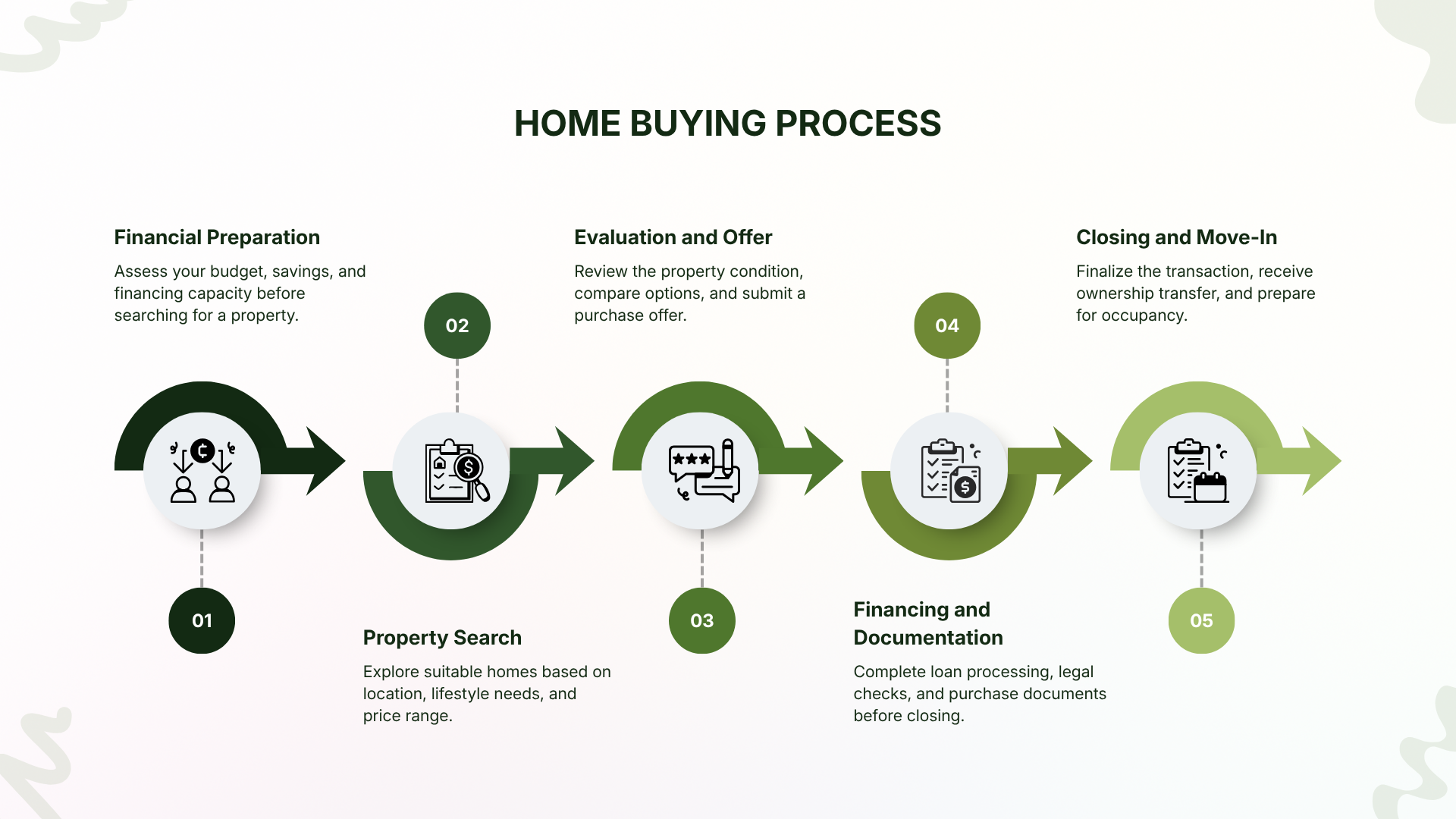
First, understand your real budget.
Then, check your loan eligibility.
After that, shortlist two or three locations.
Next, visit projects personally.
Then, compare the total cost, not only the basic price.
Also, verify RERA registration and legal approvals.
After that, compare home loan offers.
Finally, read the agreement carefully before signing.
This may sound basic, but many buyers skip these steps because they feel excited or pressured.
Do not do that.
A home is a long-term decision. Take your time.
A Small Story Most Buyers Will Understand
A family I know almost booked a larger apartment in a faraway location. The sample flat was beautiful. The sales office looked premium. The staff served coffee. The offer sounded attractive.
Everything looked perfect on Sunday afternoon.
But then they visited again on a weekday evening.
The father’s office commute took almost two hours one way. The nearest good grocery store was still far. The child’s school bus was not available. The project was nice, but daily life looked difficult.
So, they changed their decision.
Finally, they bought a slightly smaller flat in a better-connected area. It did not look as grand on paper, but it worked better for their real life.
And that is the point.
A home should not only look good during a site visit. It should work on a normal Monday morning too.
Tips for First Time Home Buyer in 2026
Here are some simple tips for first time home buyer decisions:
Do not book only because of a discount.
Do not trust only the sample flat.
Do not ignore maintenance charges.
Do not stretch your EMI too much.
Do not buy without checking approvals.
Do not forget resale and rental demand.
Do not depend only on future promises.
Do not sign anything in a hurry.
Also, take one trusted person with you when visiting a site. A second opinion helps. Sometimes another person notices what you miss.
Final Thoughts
So, is 2026 the right year to buy a home?
For many serious buyers, yes.
This home buying guide 2026 is not saying that every project is good or every buyer should purchase immediately. That would be wrong. The real message is simple: 2026 may reward buyers who are prepared, informed, and patient.
If your finances are ready, your job is stable, your family needs are clear, and you find a good property in a practical location, this may be the right time to take the next step.
However, do not buy because someone is pressuring you. Do not buy only because prices may rise. Do not buy only because the brochure looks beautiful.
Buy because the home fits your life.
After all, a house is not just an investment. It is where your quiet evenings, family meals, festivals, small arguments, big dreams, and ordinary days will happen.
Choose it with both heart and homework.
FAQs
1. Is 2026 a good year for first-time home buyers?
Yes, 2026 can be a good year for first-time home buyers if they have stable income, enough savings, and a clear budget. Buyers should compare locations, check legal approvals, and choose a home that suits both lifestyle and EMI comfort.
2. What is the best time to buy a home in 2026?
The best time to buy a home in 2026 depends on your financial readiness, home loan eligibility, project safety, and location choice. Instead of waiting for the perfect market timing, focus on buying when the property and budget both make sense.
3. What should I check before buying my first home?
Check RERA registration, builder reputation, carpet area, possession date, total cost, parking charges, maintenance cost, loan eligibility, connectivity, nearby schools, hospitals, and daily-use facilities.
4. Are home loans for first time buyers easy to get?
Home loans for first time buyers are easier to compare now because many banks and platforms provide online information. However, approval depends on income, credit score, documents, existing loans, and repayment capacity.
5. Should I buy a ready-to-move or under-construction home?
A ready-to-move home is safer if you want immediate possession and want to avoid delay risk. An under-construction home may offer better pricing or flexible payment plans, but you must check the builder’s record and legal approvals carefully.
6. Can I use affiliate links in a real estate blog?
Yes, affiliate links can be used in a real estate blog if they are useful and clearly disclosed. You may link to home loan calculators, property research tools, insurance services, or legal verification resources. Avoid adding too many links only for commission.
Author Bio
The author writes simple and practical content on real estate, home buying, property planning, and personal finance. The goal is to help readers understand important decisions in clear language before they invest their hard-earned money.
Founder’s Note
Buying a home is one of the biggest decisions in any family’s life. Our aim is to make this journey easier, clearer, and more transparent for every reader. We believe a good home decision should be based on facts, comfort, legal safety, and long-term value — not pressure, confusion, or marketing noise.