What Is the Future of Dwarka Expressway?
A few years ago, almost every conversation about Dwarka Expressway began with the word “future.”
Future road. Future metro. Future development. Future appreciation.
In 2026, that sounds slightly outdated.
A large part of that future has already arrived.
The expressway is operational. Delhi-side connectivity has improved. Urban Extension Road-II has become part of the wider road network. Yashobhoomi and IGI Airport are better integrated with the corridor. Meanwhile, residential development has moved from scattered projects to large premium communities.
Yet this doesn’t mean the Dwarka Expressway growth story is finished.
Quite the opposite.
The next phase may be less dramatic than building the expressway itself, but perhaps more important. It is about connecting the road to a larger urban ecosystem: metro connectivity, South Delhi access, commercial activity, mature neighbourhoods and everyday social infrastructure.
That is why the future of Dwarka Expressway in 2026 should not be judged only by one question:
“Will property prices rise?”
The better question is:
“What kind of city is developing around this road?”
That is where the real story begins.
From a Promise on a Map to an Actual Urban Corridor
Anyone who followed Gurugram property during the early Dwarka Expressway years will remember the uncertainty.
Projects were launched while infrastructure was still catching up. Buyers had to imagine access roads, flyovers, airport connectivity and future development.
It required patience.
Today, the experience is different.
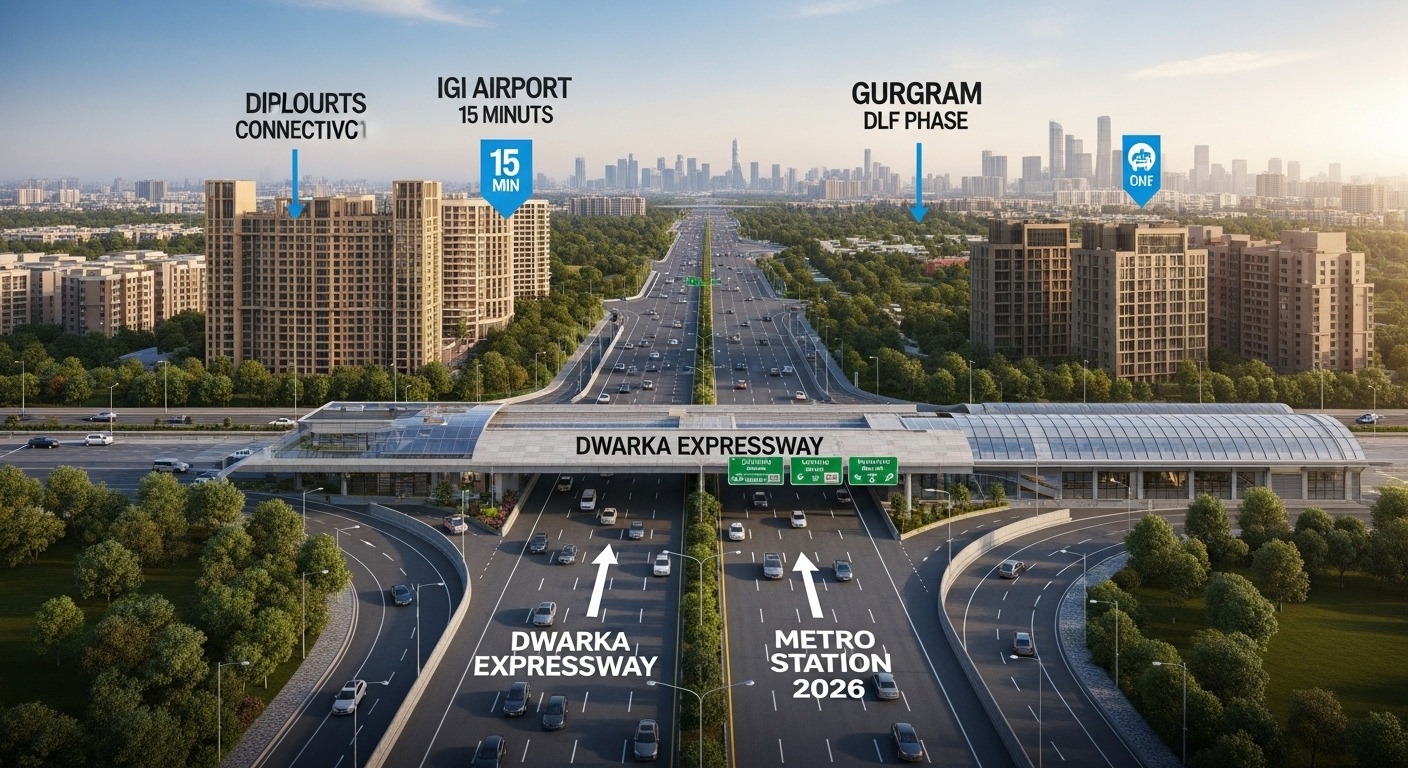
The Government describes the Delhi section of Dwarka Expressway as a 10.1 km project completed in 2025, including an eight-lane shallow tunnel and connectivity towards Yashobhoomi, metro corridors and the airport. Urban Extension Road-II, a 76 km corridor functioning as Delhi’s third ring road, was also operationalised in 2025.
So buyers can now test much more of the connectivity themselves.
That matters.
A road shown as a dotted line in a sales presentation carries one kind of risk.
A road you can actually drive on carries another.
The conversation has therefore shifted from infrastructure completion to infrastructure integration.
And that is a much more mature stage for a property market.
Market Growth Data: The Numbers Explain the Excitement
The price movement along Dwarka Expressway has already been significant.
According to a PropEquity study reported in 2025, average launch prices along the corridor increased from around ₹9,434 per sq. ft. in 2020 to ₹18,668 per sq. ft. in 2024.
That is close to a doubling in four years.
The same study reported 15,994 housing units launched between 2020 and 2024, while approximately 16,502 units were absorbed. Sectors including 113, 37D, 106, 111 and 103 accounted for a large share of supply.
Even more interesting is what may come next.
PropEquity estimated that more than 18,000 additional residential units could be launched between 2025 and 2030.
That number should make investors excited.
It should also make them cautious.
Why?
Because more development creates better neighbourhoods, stronger retail demand and a larger resident base.
However, it also creates competition.
The days when almost any apartment near Dwarka Expressway could be sold as a scarce opportunity are disappearing.
The next stage should favour better projects, better sectors and better entry prices.
Gurugram’s Larger Market Is Also Supporting the Corridor
Dwarka Expressway isn’t growing in isolation.
Gurugram itself has experienced strong housing appreciation.
ANAROCK data reported in August 2026 showed average residential values in Gurugram rising from about ₹6,150 per sq. ft. in 2019 to ₹13,350 per sq. ft. by Q2 2026, an increase of approximately 117%.
Rental yields were also reported to have improved from roughly 3.5% to 4.3% over the period.
Meanwhile, Cushman & Wakefield data cited in April 2026 showed Gurugram accounting for approximately 73% of residential launches across NCR during Q1 2026.
These numbers tell us something important.
Gurugram is no longer growing around one business district.
It is becoming a collection of strong micro-markets.
Golf Course Road had its cycle.
Golf Course Extension followed.
Southern Peripheral Road developed.
New Gurugram expanded.
Now the Dwarka Expressway belt is becoming another major urban spine.
However, past appreciation should never be treated as a promise of future returns.
Prices can pause.
Supply can increase.
Economic cycles change.
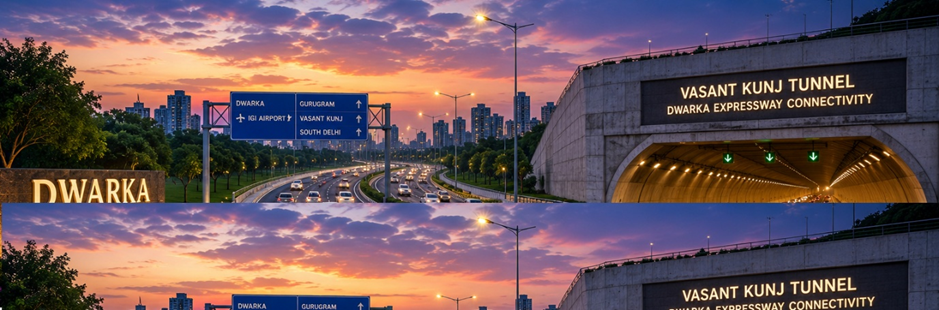
Key Future Infrastructure Pillar 1: The New South Delhi Tunnel
This may become one of the most important future developments for Dwarka Expressway.
In July 2026, the Government approved an 8.1 km, six-lane road corridor on NH-148AE connecting the Shiv Murti Interchange on Dwarka Expressway with Nelson Mandela Marg in Vasant Kunj.
The estimated project cost is ₹6,969.67 crore.
The plan includes a 3.14 km twin-tube tunnel, with part of it passing below the Southern Ridge.
Now think about what that means in practical terms.
Dwarka Expressway was initially viewed mainly as another Delhi-Gurugram connection.
The Vasant Kunj tunnel could make it increasingly relevant for South Delhi movement as well.
That opens a different connectivity equation.
Vasant Kunj. South Delhi. Airport. Dwarka. Gurugram.
All become part of a more integrated road network.
The Government has also said the corridor is intended to reduce dependence on congested routes around Mahipalpur and the airport while improving access between Gurugram, Dwarka, IGI Airport, West Delhi and South Delhi.
For a property buyer, that matters far more than another clubhouse amenity.
Connectivity changes who can realistically live in a location.
Infrastructure Pillar 2: Gurugram Metro
Roads created the first stage of the Dwarka Expressway story.
Rail-based public transport could shape the next.
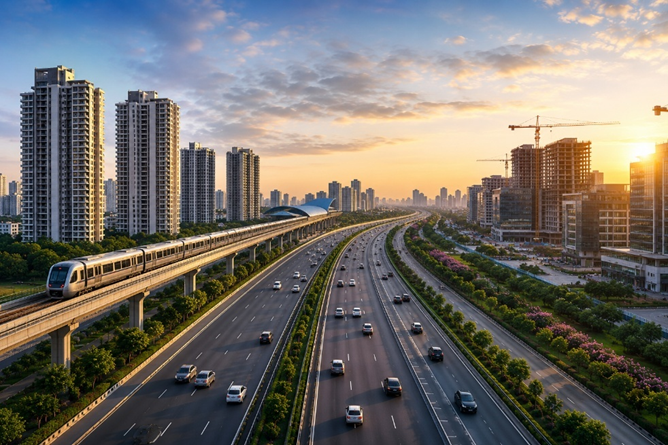
Gurugram Metro Rail Limited says the sanctioned Gurugram Metro corridor will cover approximately 28.5 km with 27 elevated stations.
More importantly for this corridor, the plan includes a 1.85 km spur from Basai Village towards Dwarka Expressway, including a station at Sector 101.
The wider route is designed to connect Millennium City Centre with Cyber City while integrating old and new Gurugram.
This could be a major shift.
Expressways are excellent for cars.
Cities, however, do not mature on cars alone.
Metro access can change commuting patterns for employees, domestic staff, students, service workers and residents who do not want every trip to depend on a private vehicle.
Still, buyers should remain practical.
A sanctioned or developing metro should be treated as a future advantage until it becomes operational.
Don’t pay tomorrow’s full premium today simply because a sales executive points towards a future station.
Infrastructure Pillar 3: UER-II and the Wider NCR Road Network
One thing that is often missed in Dwarka Expressway discussions is the importance of UER-II.
Urban Extension Road-II is a roughly 76 km road developed as Delhi’s third ring road. The Government says it has improved links towards Bahadurgarh and Sonipat while supporting freight movement and reducing pressure on existing corridors.
This matters because successful property corridors rarely depend on one road.
They become valuable when multiple roads start talking to each other.
Dwarka Expressway.
UER-II.
NH-48.
Airport access.
Future South Delhi tunnel connectivity.
Metro.
Put these together and the corridor starts looking less like a highway surrounded by apartments.
It starts looking like a transport network.
That is a completely different proposition.
Infrastructure Pillar 4: Yashobhoomi, Airport and Commercial Activity
Another reason the corridor deserves attention is the economic activity around Delhi’s airport and Dwarka.
The Delhi section of Dwarka Expressway already provides connectivity towards Yashobhoomi and IGI Airport.
This creates something residential property markets need badly:
reasons for people to travel to the area even when they don’t live there.
Convention activity brings visitors.
Hotels follow visitors.
Offices follow connectivity.
Restaurants follow residents and offices.
Retail follows all of them.
Then schools and healthcare improve because the permanent population grows.
It doesn’t happen overnight.
Usually it happens almost invisibly.
One restaurant opens.
Then a supermarket.
Then another school bus appears in the morning.
A few years later, an area that once felt empty suddenly feels like part of the city.
That is the evolution investors should watch.
The Evolution: Dwarka Expressway Is Entering Its Second Life
The first life of Dwarka Expressway was mostly about infrastructure speculation.
“Will it get built?”
The second life is about urbanisation.
“What will develop around it?”
That sounds like a small difference.
It isn’t.
A functioning expressway gets people from A to B.
A mature urban corridor gives people reasons to stop between A and B.
Homes.
Offices.
Schools.
Hospitals.
Restaurants.
Retail.
Entertainment.
Public transport.
That is how real estate value becomes more durable.
And this is probably where Dwarka Expressway is heading next.
A Sunday Drive That Explains the Change
Imagine someone who last visited this belt six years ago.
They remember empty land, construction barricades and long detours.
Now they return on a Sunday.
The road feels different.
More towers are visible.
More families are visiting projects.
Traffic is no longer made up mainly of construction trucks.
A child in the back seat asks where the nearest mall is.
That question sounds ordinary.
But it marks an important stage.
Once residents stop asking “When will the road come?” and start asking “Where do we shop, eat and send the children to school?”, the property market has entered a new phase.
That phase can create long-term value.
It can also expose weak projects.
Will Dwarka Expressway Property Prices Continue to Rise?
Probably the most searched question is also the one nobody can answer with certainty.
There are reasons to remain positive.
Connectivity is improving. Gurugram remains a powerful employment centre. Metro plans support future mobility. New road links are planned. Premium residential development continues.
However, there are reasons to be selective.
Prices have already risen substantially.
Thousands of new homes are expected to enter the corridor over the coming years.
Therefore, future appreciation may not be uniform.
A well-designed project near strong infrastructure may perform differently from an average development several kilometres away.
The developer matters.
The sector matters.
The unit matters.
The price you pay matters even more.
This is why I would not describe Dwarka Expressway in 2026 as an “early-stage investment.”
That period has passed.
I would describe it as a maturing infrastructure-led market with further growth potential but much greater need for selection.
That is less exciting than saying “prices will double.”
What Could the Corridor Look Like by 2030?
By 2030, the most meaningful change may not be another dramatic rise in apartment prices.
It may simply be normality.
More occupied towers.
Better retail.
Shorter dependence on distant markets.
More schools.
More healthcare.
Improved public transport.
Greater commercial activity.
And fewer conversations beginning with “this will come in the future.”
If the approved transport projects progress as planned, the corridor could become increasingly integrated with Gurugram, Dwarka, the airport and South Delhi.
That is the real long-term opportunity.
Not a road.
An urban district.
The Future of Dwarka Expressway: Final View
Dwarka Expressway has already delivered the first part of its promise.
The road exists.
Connectivity has improved.
Property prices have responded.
Now comes the harder part.
Building a place where people genuinely want to live for the next twenty years.
The next growth cycle will depend on metro access, new Delhi connections, commercial development, social infrastructure and how well thousands of new residents are absorbed into the area.
That means the future still looks interesting.
But it won’t reward every purchase equally.
Buyers should stop asking only:
“Which project will appreciate fastest?”
Start asking:
“Which location will become easiest to live in?”
Over the long run, those two answers often become surprisingly similar.
Frequently Asked Questions
What is the future of Dwarka Expressway?
The corridor has moved from infrastructure speculation towards urban development. Its future is likely to depend on metro connectivity, South Delhi road links, airport access, commercial development and improved social infrastructure. Major projects such as the Gurugram Metro spur and the approved Vasant Kunj tunnel strengthen the long-term connectivity case.
Have property prices increased on Dwarka Expressway?
Yes. A PropEquity study reported launch prices rising from around ₹9,434 per sq. ft. in 2020 to ₹18,668 per sq. ft. in 2024.
Is Dwarka Expressway good for investment in 2026?
It can be attractive for long-term investors, but prices have already risen substantially. Buyers should now focus on sector, developer quality, total acquisition cost, infrastructure access and competing supply rather than assuming every property will appreciate equally.
Is metro connectivity planned for Dwarka Expressway?
Yes. Gurugram Metro Rail Limited’s sanctioned 28.5 km corridor includes a 1.85 km spur from Basai Village towards Dwarka Expressway, with Sector 101 listed on the spur.
What new tunnel is planned near Dwarka Expressway?
The Union Government approved an 8.1 km six-lane corridor connecting Shiv Murti on Dwarka Expressway with Nelson Mandela Marg in Vasant Kunj. The project is estimated at ₹6,969.67 crore and includes a 3.14 km twin-tube tunnel.
Will Dwarka Expressway prices double again?
There is no reliable way to guarantee that. Past appreciation has been strong, but future returns will depend on entry prices, supply, infrastructure execution, demand and individual project quality.