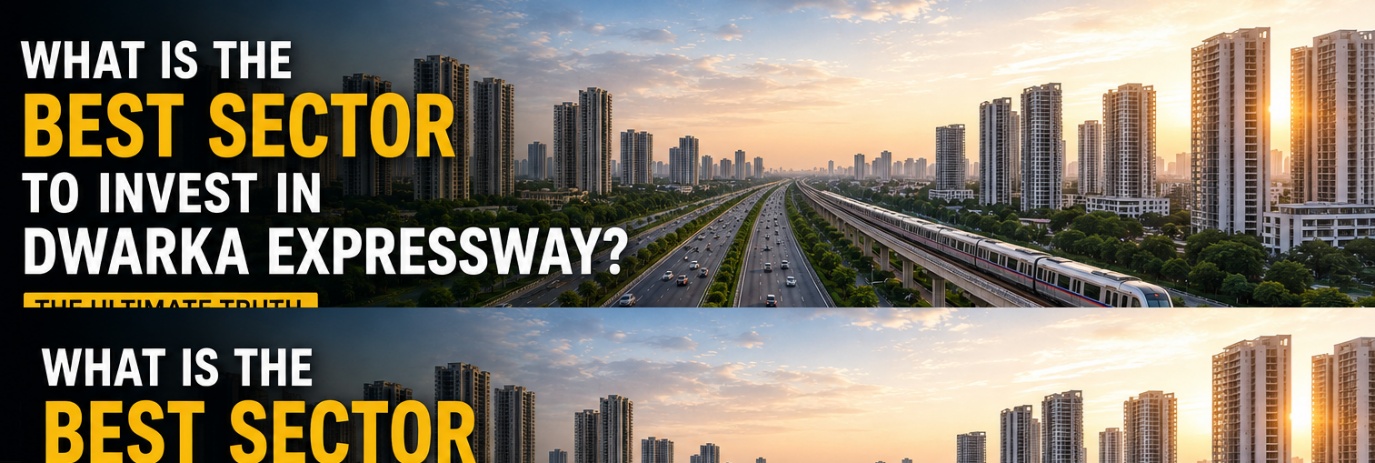
What Is the Best Sector to Invest in Dwarka Expressway? The 2026 Answer Is Not as Simple as It Sounds
Ask five property brokers which is the best sector to invest in Dwarka Expressway, and there is a good chance you will hear five different answers.
One will say Sector 113 because it is closer to Delhi.
Another will choose Sector 106 because luxury development is gathering pace there.
Someone else will insist Sector 102 still offers better value.
And the person selling a project in Sector 37D will probably tell you that paying ₹5 crore for an apartment closer to Delhi makes absolutely no sense.
The confusing part?
Each of them can be partly right.
That is the first thing buyers need to understand about Dwarka Expressway in 2026. It is no longer one uniform property market. It has become a collection of very different micro-markets, each appealing to a different kind of buyer.
The expressway itself is operational, Delhi-side connectivity has improved, and the wider corridor is gaining additional infrastructure through the Gurugram Metro plan, UER-II and the newly approved connection towards Vasant Kunj and South Delhi.
So the investment question has changed.
It is no longer:
“Should I buy on Dwarka Expressway?”
It is:
“Which part of Dwarka Expressway matches the kind of investor I am?”
That is a much better question.
The Ultimate Truth: There Is No Single Best Sector
Here is the answer most property advertisements will not give you.
There is no universally best sector on Dwarka Expressway.
If your budget is ₹1.5–2 crore, the answer is different from someone deploying ₹6 crore.
If you want to live in the property, your priorities are different from an investor planning to exit before possession.
If regular Delhi access matters, a Delhi-facing sector may justify paying more.
If you are investing for rental yield, however, paying the highest capital value may actually work against you.
And if you are hoping for aggressive appreciation, you may have to accept more construction and execution risk.
This is why sector rankings without investor context are almost meaningless.
The market numbers themselves show how different the corridor has become.
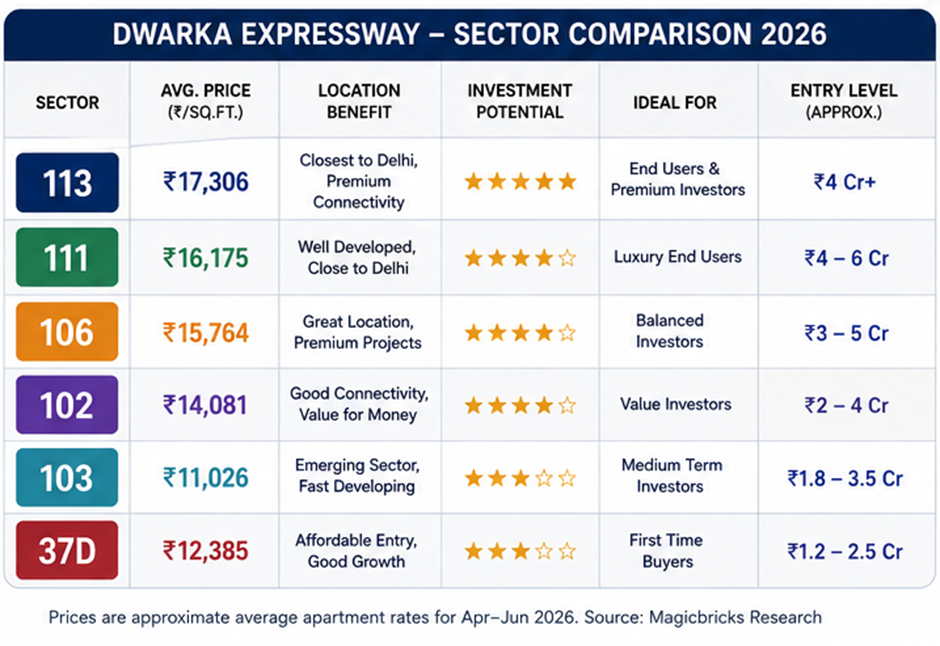
Magicbricks’ April–June 2026 data puts the average multistorey apartment value across Dwarka Expressway at roughly ₹14,661 per sq. ft. Yet sector averages vary widely. Sector 37D was around ₹12,385 per sq. ft., Sector 102 around ₹14,081, Sector 106 about ₹15,764, Sector 111 roughly ₹16,175 and Sector 113 approximately ₹17,306 per sq. ft.
Even these averages need care.
A premium new project can trade far above its sector average. For example, individual projects in Sector 103 and Sector 108 were quoted substantially above their respective locality averages during Q2 2026.
So never buy a ₹25,000-per-sq.-ft. apartment because somebody tells you, “Sector average is only ₹12,000, so there is huge upside.”
That is not how valuation works.
Compare project with project, not just sector with sector.
If I Had to Pick One Overall Sector: Sector 106
If the question is narrowed to:
“Which sector gives me the best overall balance of location, premium development, future demand and still-reasonable entry compared with the most expensive Delhi-facing sectors?”
My 2026 answer would be:
Sector 106.
Not because it is cheap.
It isn’t.
The average apartment rate was around ₹15,764 per sq. ft. in April–June 2026, according to Magicbricks.
Rather, Sector 106 sits in an interesting middle ground.
It has attracted large premium developments and recognised developers. It is firmly part of the Dwarka Expressway corridor, while its average pricing remains below Sector 111 and Sector 113.
A typical 3 BHK in Sector 106 was averaging around ₹3.1 crore in Q2 2026, although individual projects can be considerably more expensive.
That gives Sector 106 something investors often overlook:
room to serve both end users and premium investors.
That matters because the healthiest resale markets are rarely driven only by investors selling to other investors.
Eventually, someone needs to want to live there.
Categorise by Investor Intent — This Is the Smarter Way to Choose
1. Best for Aggressive Premium Growth: Sector 113
Sector 113 is probably the clearest choice for someone who wants the Delhi-facing premium story.
It sits towards the Delhi border side of the Gurugram corridor and is already one of the more expensive Dwarka Expressway sectors.
Magicbricks showed average values of around ₹17,306 per sq. ft. in 2026, with available apartments spanning a wide range depending on project and configuration.
The attraction is easy to understand.
As infrastructure improves between Dwarka, Gurugram, IGI Airport and South Delhi, the Delhi-facing sectors gain strategic importance.
Delhi Development Authority records also show the planned Second Diplomatic Enclave in Sector 24, Dwarka, strengthening the broader premium development story on the Delhi side.
But there is a catch.
A lot of optimism is already priced in.
Sector 113 therefore makes more sense for an investor comfortable paying a premium for location quality and future scarcity than for someone hunting for a bargain.
Investor profile: high budget, 5–8+ year horizon, premium appreciation focus.
2. Best Overall Balance: Sector 106
Sector 106 gets my vote for the balanced investor.
You are not paying the absolute top-end average of Sector 113, yet you remain in a premium section of the corridor.
More importantly, Sector 106 was one of five micro-markets—alongside 113, 37D, 111 and 103—that accounted for roughly 74% of housing supply along the corridor between 2020 and 2024, according to PropEquity data reported in 2025.
That means the sector is not a theoretical future address.
It is already part of the corridor’s active residential ecosystem.
And there is something reassuring about that.
Sometimes I would rather buy in a sector where several credible residential communities are competing for buyers than in an isolated location where one project looks impressive only because there is nothing around it.
Investor profile: ₹3–6+ crore budget, balanced appreciation and end-use potential.
3. Best for Delhi-Side Luxury End Users: Sector 111
Sector 111 feels different from a purely speculative investment market.
It already contains established high-end development alongside newer ultra-luxury supply.
The sector’s average apartment price was about ₹16,175 per sq. ft. in Q2 2026, according to Magicbricks.
However, the project range is enormous.
Ready homes can trade at one price, while newer luxury offerings can run into very high ticket sizes. Current 4 BHK listings illustrate values from under ₹4 crore to well above ₹10 crore depending on project and construction stage.
This is why Sector 111 suits someone buying quality and location, not simply the lowest cost per square foot.
For an end user who regularly travels towards Delhi and has a larger budget, it deserves serious consideration.
Investor profile: luxury end user, long holding period, capital preservation more important than bargain entry.
4. Best Value Play: Sector 102
Sector 102 is interesting precisely because it does not always receive the same glamorous headlines as 113 or 106.
The average apartment rate in Q2 2026 was approximately ₹14,081 per sq. ft., below Sector 106, 111 and 113.
Three-bedroom apartments were averaging roughly ₹2.73–2.74 crore in the quarter, although there are large differences between older and newly launched projects.
That variation can create opportunity.
A buyer who knows the difference between a strong resale property and an overpriced new launch may find better risk-adjusted value here than in a heavily marketed luxury sector.
There is another future factor.
The sanctioned Gurugram Metro includes a 1.85 km spur from Basai Village towards Dwarka Expressway, with Sector 101 on the spur.
Sector 102 sits within this broader zone.
However, don’t pay the full value of future metro connectivity today.
Let the infrastructure become your upside.
Not your excuse for overpaying.
Investor profile: value-conscious investor, ₹2–4 crore range, willing to compare resale and new launches carefully.
5. Best Emerging Value + Premium Mix: Sector 103
Sector 103 may be the most interesting example of why averages can deceive.
The average apartment rate was around ₹11,026 per sq. ft. in Q2 2026. Yet individual premium developments were quoted around ₹19,000–₹24,000 per sq. ft. during the same period.
That is a huge spread.
It tells you that Sector 103 is undergoing a transition.
Older stock, newer luxury projects, affordable units and premium development can coexist within one pin code.
For a knowledgeable buyer, that can create opportunities.
For an inexperienced buyer, it can create expensive mistakes.
Sector 103 therefore works best for investors willing to do detailed project-level homework rather than simply buying the newest launch.
Investor profile: medium-term investor, value hunter, comfortable comparing older resale stock with premium new supply.
6. Best Lower-Ticket Entry: Sector 37D
Not every Dwarka Expressway investor has ₹4–5 crore available.
Sector 37D remains one of the more approachable entry points.
Its average multistorey apartment value was around ₹12,385 per sq. ft. in Q2 2026, while 3 BHK units were averaging approximately ₹2.45 crore and some resale options were available for less.
Does it have the prestige of Sector 113?
No.
Does it have the same Delhi-proximity story?
No.
But that is precisely why it costs less.
The investment case here depends more on affordability, populated communities, city-side connectivity and gradual neighbourhood improvement.
Sometimes the best percentage return does not come from the most glamorous address.
It comes from buying a usable property at the right price.
Investor profile: lower entry budget, practical buyer, end-use + investment combination.
What About Sector 108?
Sector 108 deserves a special mention because it is stronger for end-use and established premium living than its sector-wide average alone suggests.
The Q2 2026 apartment average was approximately ₹11,697 per sq. ft., while premium projects such as SOBHA City were trading far higher, with one phase averaging above ₹21,000 per sq. ft.
Again, that gap tells the real story.
Buyers pay for the project.
Not the sector number printed on Google.
For someone who prioritises completed or relatively mature premium communities, Sector 108 can be more comfortable than chasing a purely future-led launch.
A Simple Investor Scenario
Imagine two friends.
Both have ₹3 crore.
One says:
“I want the sector closest to Delhi.”
He stretches his budget, buys a smaller unit at a premium and waits for appreciation.
The second says:
“I want the best quality home I can buy without exhausting my capital.”
She buys a stronger unit slightly further down the corridor, keeps ₹30–40 lakh available for registration, interiors and financial flexibility, and holds for seven years.
Five years later, who wins?
You cannot know from the sector number alone.
Entry price changes everything.
That is why real estate investment is not simply about finding the “best location.”
It is about finding the best relationship between location and price.
Investment Advice: Seven Things I Would Check Before Buying
First, compare at least three actual properties with similar sizes. A 2,500 sq. ft. home at ₹18,000 per sq. ft. should not be compared with a 1,600 sq. ft. apartment simply because both are called “3 BHK.”
Second, check the total acquisition cost, not the advertisement price.
Add stamp duty, registration, taxes where applicable, parking, maintenance deposits, club charges, financing cost and interiors.
Third, verify the Haryana RERA registration for the exact phase or tower.
Fourth, drive through the location yourself.
Do it on a weekday.
At 6 pm.
A Sunday site visit tells you how beautiful the sales gallery looks.
A Monday commute tells you what the property actually feels like.
Fifth, don’t overvalue proposed infrastructure.
The Gurugram Metro spur towards Dwarka Expressway is real and sanctioned, and civil-tender activity has taken place. However, until a service is operational, it remains future infrastructure.
Sixth, remember that supply is coming.
PropEquity projected more than 18,000 additional residential units along the corridor between 2025 and 2030.
More supply can improve neighbourhoods.
It can also create resale competition.
Finally, ask a question almost nobody asks in a sales office:
“Who will buy this apartment from me five years later?”
If you cannot picture that buyer, reconsider the investment.
The Infrastructure Argument Is Still Strong
Dwarka Expressway’s investment case is not based only on housing launches.
The Gurugram Metro’s sanctioned 28.5 km route includes a 1.85 km spur towards Dwarka Expressway.
The Delhi section of Dwarka Expressway has already strengthened links with Yashobhoomi, metro corridors and IGI Airport. UER-II has also expanded regional road connectivity.
Then, in July 2026, the Union Government approved an 8.1 km six-lane corridor connecting Dwarka Expressway with Nelson Mandela Marg in Vasant Kunj, including a major twin-tube tunnel component. The project carries an estimated cost of ₹6,969.67 crore.
That makes the longer-term connectivity story stronger.
But infrastructure should improve a good investment.
It should not be used to justify a bad entry price.
My 2026 Ranking by Investor Type
| Investor Goal | Sector to Examine First |
| Best overall balance | Sector 106 |
| Premium appreciation / Delhi proximity | Sector 113 |
| Luxury end-use | Sector 111 |
| Value investing | Sector 102 |
| Emerging mixed-price opportunity | Sector 103 |
| Lower-ticket entry | Sector 37D |
| Established premium communities | Sector 108 |
These are starting points for research, not automatic buy recommendations.
Final Verdict: So Which Is the Best Sector?
If someone forced me to choose one sector in 2026 without knowing anything else about the buyer, I would start with Sector 106.
It offers a useful middle ground between premium positioning and the very high valuations of the most Delhi-facing sectors.
For aggressive luxury appreciation, I would study Sector 113.
For an end-user-oriented luxury purchase, I would look carefully at Sector 111 and 108.
For stronger value, Sector 102 and 103 deserve more attention than they sometimes receive.
And if the budget is tighter, Sector 37D should not be dismissed simply because it is less fashionable.
The ultimate truth is simple.
The best sector is not the one with the loudest launch campaign.
It is the sector where your purchase price, location, project quality and future buyer demand all make sense together.
That usually takes more work.
But in real estate, the homework done before signing the cheque is often where the profit is made.
Frequently Asked Questions
Which is the best sector to invest in Dwarka Expressway in 2026?
There is no single best sector for every investor. Sector 106 offers one of the strongest overall balances, while Sector 113 suits premium Delhi-facing investors, Sector 102 offers better value, and Sector 37D has a lower entry threshold.
Is Sector 113 better than Sector 106?
Sector 113 has stronger Delhi-facing positioning and higher average prices. Sector 106 is generally less expensive on a sector-average basis and may offer a more balanced risk-reward equation.
Is Sector 102 good for investment?
Sector 102 can be attractive for value-focused buyers because its average apartment pricing remains below several premium Dwarka Expressway sectors. Buyers should compare individual projects carefully.
Which sector is best for a lower budget?
Sector 37D generally provides a lower entry point than Delhi-facing premium sectors, although project quality and apartment size still create major price differences.
Which Dwarka Expressway sector is closest to future metro connectivity?
The sanctioned Gurugram Metro plan includes a spur towards Dwarka Expressway with Sector 101 on the spur, making sectors around the 101–103 belt worth watching for the longer term.
Will all Dwarka Expressway sectors appreciate?
No. Supply, developer quality, entry price, infrastructure execution, resale demand and overall economic conditions will influence future performance. Past appreciation does not guarantee future returns.