
Miyawaki Forest & Urban Green Spine: How Gurgaon’s AQI Story is Quietly Changing (2026)
There’s something you begin to notice after living in Gurgaon for a while.
It’s not just the traffic.
Not even the construction.
It’s the air.
Some mornings feel heavier. You step outside, take a breath, and even before opening any app… you can tell the AQI isn’t great.
And if you’ve ever been stuck near NH-8 around 7 PM, windows rolled up, AC on full… you already know why this matters.
Because slowly, people are no longer choosing homes based only on location or price.
They’re thinking about something far more basic.
Air. Space. Health.
And that’s exactly where Miyawaki forest and urban forest planning in Gurgaon is starting to change the conversation—especially along the Dwarka Expressway.
The Shift No One Really Talked About
For years, the Gurgaon real estate story was simple:
Closer to office = better decision.
That was the logic.
But somewhere along the way, that logic started to feel incomplete.
Now when buyers visit projects, the questions sound different:
“How’s the air quality here?”
“Is there enough green around?”
“Will this area feel livable after 5–10 years?”
These weren’t common questions earlier.
But after experiencing poor air quality year after year… priorities have shifted.
And you can feel that shift on ground.
What is a Miyawaki Forest
Let’s not complicate it.
A Miyawaki forest is not a park with walking tracks and benches.
It’s dense. Almost wild.
Trees are planted close together. Different native species grow at the same time. And because of this, the forest grows faster—much faster.
In fact:
- Growth is nearly 10x quicker
- Density is up to 30x higher
- Oxygen output improves significantly
But here’s what that really means in real life:
More shade
Less dust movement
Slightly cooler surroundings
It’s like creating a small natural shield inside the city.
And Gurgaon has started adopting this approach in pockets.
The “Green Spine” Along Dwarka Expressway
Now this is where things start connecting.
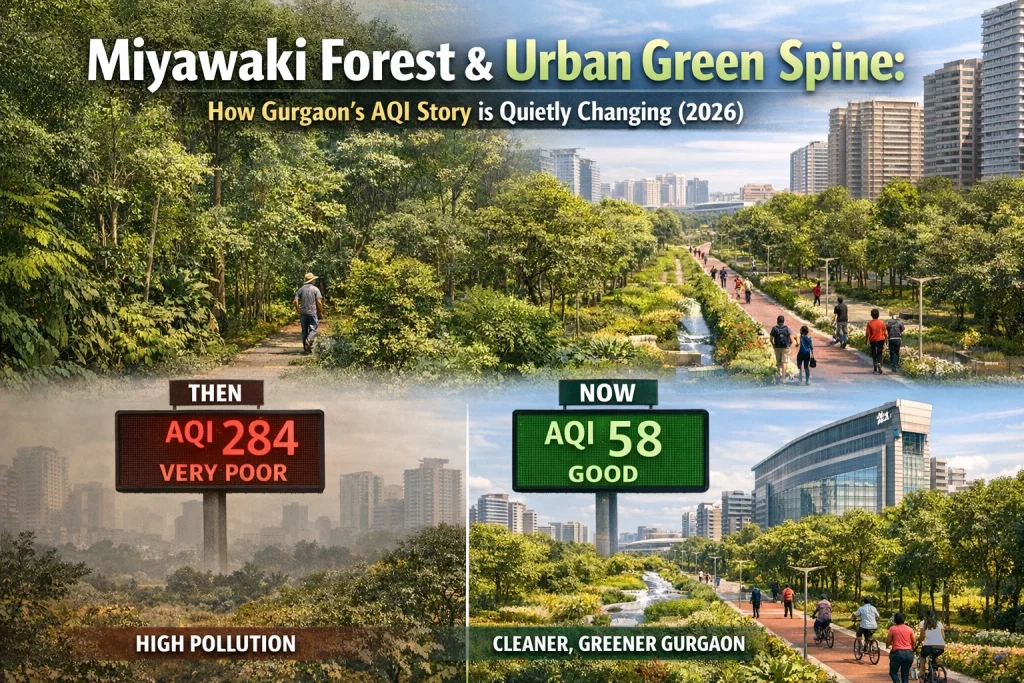
There’s a quiet but noticeable push to create a green spine along the Dwarka Expressway stretch.
Not one big forest.
But multiple connected green elements:
- Miyawaki forest patches
- Linear plantations
- Roadside dense green buffers
- Landscaped open zones
Individually, these may not seem massive.
But together?
They create a continuous layer of green between traffic corridors and residential areas.
And that changes how a place feels.
1.5 Lakh Trees — What It Feels Like
We often hear numbers like “1.5 lakh trees planted.”
Sounds impressive.
But what does it actually feel like when you’re standing there?
You notice small things:
The air doesn’t feel as dry.
Dust doesn’t rise as aggressively near roads.
Even the sunlight feels softer in certain pockets.
No, it’s not dramatic.
Gurgaon isn’t turning into a forest city overnight.
But the difference?
It’s slowly becoming noticeable.
And for many homebuyers, that small difference is enough to pause and think.
Gurgaon AQI: A Practical Comparison Buyers Are Making
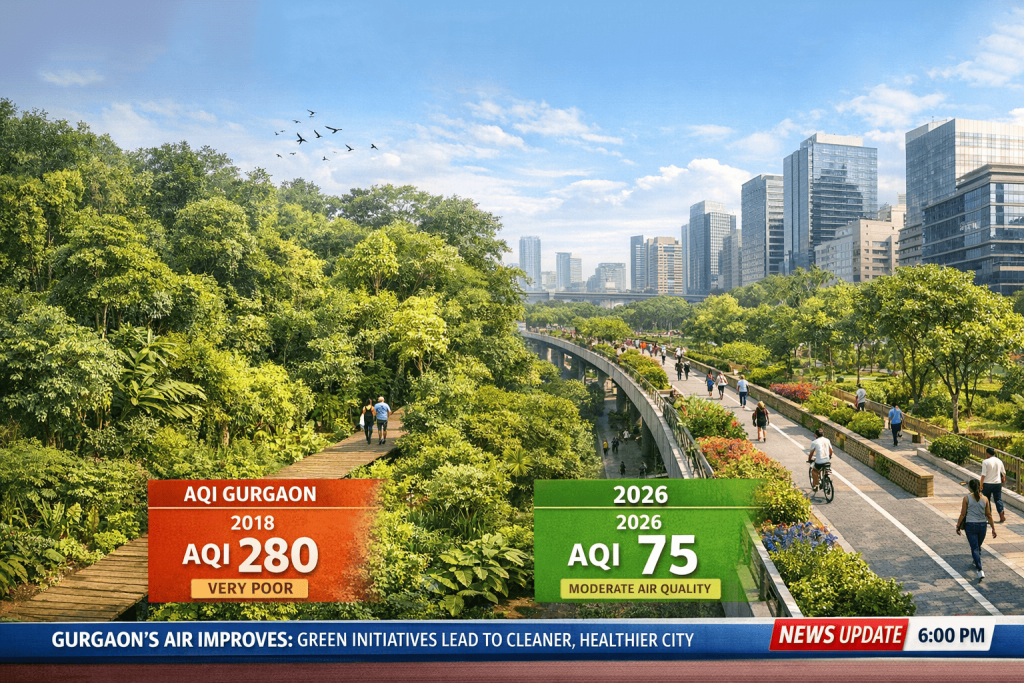
Let’s talk real.
Central Gurgaon (Older Zones)
Areas around:
- NH-8
- Cyber City
- MG Road
Still deal with:
- Heavy traffic flow
- Limited green buffers
- Constant construction activity
Which directly impacts Gurgaon AQI levels, especially during peak seasons.
Dwarka Expressway Sectors (Emerging Belt)
Now compare that with newer sectors:
- Wider roads
- Planned layouts
- Open spaces
- Increasing green interventions
The AQI isn’t perfect here either.
But over time, it feels more stable.
And honestly, that consistency matters more than occasional spikes.
Why Sector 106 & 103 Are Suddenly Getting Attention
This is something many people are noticing now.
Gurgaon Sector 106 and Sector 103 weren’t always the first choice earlier.
But today, they’re being discussed more seriously.
Why?
Because they offer something rare in NCR:
Breathing space
Not just metaphorically.
Literally.
Lower density means:
- Fewer towers packed together
- Better airflow between buildings
- More sunlight
- Less visual clutter
And when you combine this with nearby urban forest planning, the difference becomes more meaningful.
A Small Real-Life Moment
Last month, while visiting a project in Sector 106 around late afternoon, something interesting happened.
A family that had already seen properties in central Gurgaon walked in.
They didn’t say much initially.
They just stood near the balcony for a few minutes.
Then one of them said quietly:
“It feels lighter here.”
No technical terms. No AQI numbers.
Just that one line.
And sometimes, that’s enough.
Wellness Homes: From Marketing Term to Real Demand
A few years ago, “wellness homes” sounded like a brochure keyword.
Today, it’s becoming a deciding factor.
Buyers now actively look for:
- Cross ventilation
- Green views
- Less noise exposure
- Cleaner surroundings
Developers have noticed this shift.
That’s why you now see:
- Eco-friendly homes
- Green-certified buildings
- Landscaped zones
- Air filtration systems
Because expectations have changed.
And they’re not going back.
Why Eco-Friendly Family Homes Are Rising
Families today are planning differently.
Earlier, focus was on:
- Distance to office
- Nearby schools
- Property price
Now, there’s an added layer:
Long-term health
Parents are thinking:
“What will this environment feel like after 10 years?”
That’s why eco-friendly homes and wellness-focused communities are gaining traction—especially along Dwarka Expressway.
In fact, as per recent housing demand trends in NCR, first-time buyers now form a significant share of bookings in emerging corridors like this.
How This Is Shaping Real Estate Gurgaon
If you connect everything, the pattern becomes clear:
Better connectivity
- Green infrastructure
- Lower density living
- Higher demand
That’s exactly what’s happening in real estate Gurgaon today.
It’s no longer just about reaching office faster.
It’s about living better.
Something Most Buyers Won’t Say Out Loud
Here’s the truth.
Most people don’t check AQI apps daily.
But they feel the difference.
They notice:
- Dust settling faster on furniture
- Air feeling heavier in some areas
- Lack of open breathing space
And when they visit a place that feels even slightly better…
They remember it.
That memory influences decisions more than any data sheet.
Should You Consider Dwarka Expressway Property?
Let’s keep it simple.
You should consider it if:
- You value better air quality
- You’re planning long-term living
- You prefer modern layouts
- You’re looking for family-friendly spaces
You may want to skip if:
- You need fully developed surroundings immediately
- You’re focused only on rental returns
- You prefer already established zones
A Practical Tip
Don’t depend only on maps or project presentations.
Go there.
Stand for 10 minutes.
Visit once in the afternoon. Maybe again in the evening.
Because sometimes, the biggest difference isn’t visible on paper.
It’s something you feel.
FAQs
1. What is a Miyawaki forest?
A dense, fast-growing urban forest that improves air quality and biodiversity.
2. Is Gurgaon AQI improving?
In some sectors with green initiatives, there are gradual improvements.
3. Why are Sector 106 and 103 in demand?
Due to lower density, better planning, and growing green infrastructure.
4. Are eco-friendly homes worth it?
Yes, especially for long-term comfort and healthier living.
5. Is Dwarka Expressway good for families?
Yes, particularly for those looking for modern, planned, and evolving neighborhoods.
Gurgaon’s story is changing.
First, it was about speed.
Then, it became about connectivity.
Now, it’s about how a place feels to live in.
And initiatives like Miyawaki forests and urban green corridors are quietly shaping that future.
Because in the end…
A home is not just where you stay.
It’s where you breathe.